Stewardship in Action: A Ridgerunner’s Journey in Shenandoah
When the Potomac Appalachian Trail Club (PATC) faced delays in receiving park funding for their Ridgerunner Program, the Trust responded quickly to ensure this vital support along the Appalachian Trail was not impacted. The Trust stepped up to fund the Ridgerunner Program in the interim so this important resource for hikers along the trail would be met and hiker safety could be reinforced.
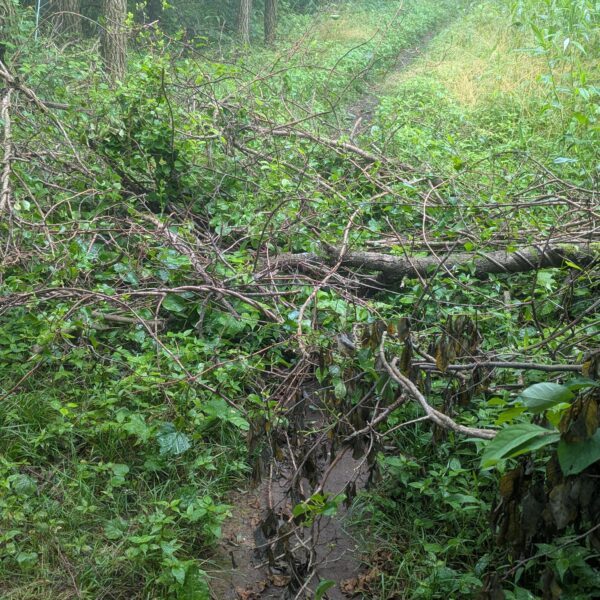

Keeping Shenandoah beautiful one trail at a time! Pre trail maintenance images.
Marissa Fulton, who worked as a Ridgerunner along the 101 miles of the Appalachian Trail (AT) in Shenandoah earlier this year, was struck by the impact of her role within Shenandoah National Park’s interconnected ecosystem. Her duties alone spanned almost every division in the park, from reporting wildlife activity, maintaining trails, and monitoring the use of historic structures to educating visitors and assisting with backcountry rescues.

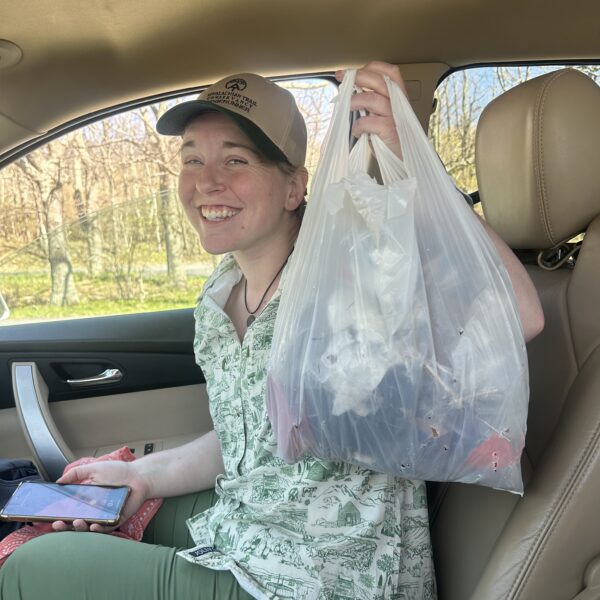
Trail maintenance complete!
Fulton often found herself in the right place at the right time, whether that meant recovering trash taken by a food-habituated bear, clearing overgrown vegetation, or being near enough to hear an injured hiker’s call for help, as she was on the 4th of July.
“I wasn’t supposed to be in that section of the park, but the holiday and training shifted what I was doing, so I ended up at Gravel Springs Hut, exactly where I needed to be,” she shared. “I heard screams from up the trail. A day-hiker tripped and dislocated her elbow, which is really painful. I was able to stabilize her arm and calm her down, and we got her out to an ambulance.”
That rescue experience opened her eyes to how the park functions behind the scenes. She witnessed the benefits of an established Search & Rescue team, free emergency services, attentive law enforcement, informed hikers, and how all those things overlap to make Shenandoah a safer, more accessible place.
Fulton was impressed with how well visitors and staff cared for the park. “Being a Ridgerunner in Shenandoah has allowed me to connect with so many individuals and parts of the park,” she said. “A lot of the connections I’m making come from filing a weekly report that goes to all the people who can respond to issues they might not have been aware of if I weren’t on the ground seeing these things.”
Fulton was impressed with how well visitors and staff cared for the park. “Being a Ridgerunner in Shenandoah has allowed me to connect with so many individuals and parts of the park,” she said. “A lot of the connections I’m making come from filing a weekly report that goes to all the people who can respond to issues they might not have been aware of if I weren’t on the ground seeing these things.”
The impact of Fulton’s presence on the trail is not only practical, but also inspirational. While her reports help the park address cross-divisional challenges, she has also seen individual conversations with hikers have an exponential effect on park stewardship.
“Educating people on everything that goes into taking care of the trail inspires people to invest in the trail themselves,” Marissa explained. “They’re inspired to take a trash bag out on their next hike, to enjoy nature, and to get involved.”
For Fulton, seeing the impact of her dedication, joined with support from the Trust, has been a life-changing experience: “Seeing the impact that your donation has really inspired me,” she said. “In the situations I’ve been in, I’m so thankful I was there. It’s making an impact on both hikers and the trail itself.”
Your investment enables the Shenandoah National Park Trust to address the park’s most pressing needs with purpose and impact. We are especially thankful for collaborative partners like the Potomac Appalachian Trail Club, whose dedication and shared vision help bring essential programs—like the Ridgerunner initiative—to life.